Gentle Exercises for Diastasis Recti After C-Section
Discover safe and gentle exercises for diastasis recti after C-section recovery. Learn how to reconnect with your core, from breathing to gradual strengthening.
Finding Your Core Again: Gentle Exercises for Diastasis Recti After C-Section Recovery
Recovering after a C-section and navigating diastasis recti can be challenging. Your body has just undergone major surgery and birth, and your core has been significantly impacted. Rebuilding strength gently and safely is a powerful act of self-care. This guide offers a pathway to reconnect with your body through gentle exercises for diastasis recti after c-section recovery.
Understanding Diastasis Recti and C-Section Recovery
What Exactly Is Diastasis Recti?
Diastasis Recti (DR) is often described as a "pooch" or "doming" in the abdomen. Medically, it's a separation of the left and right abdominal muscles (rectus abdominis) that run from your rib cage to your pelvis. These muscles are connected by the linea alba, a fibrous band. During pregnancy, hormones relax connective tissues, and the growing uterus pushes the abdominal muscles apart. This separation can persist postpartum.
How a C-Section Impacts Core Recovery
A C-section is major abdominal surgery. The surgeon cuts through layers of muscle and fascia, directly impacting the core muscles. This can exacerbate existing diastasis recti or create new weaknesses. The healing incision and internal recovery mean your abdominal wall is compromised in multiple ways.
The "Gentle" Approach: Protecting Against Re-Injury
Because both DR and a C-section involve compromised connective tissue and muscle layers, rushing into intense abdominal exercises can be counterproductive. The goal isn't to "crunch" your way to a flat stomach. Instead, we focus on re-establishing proper breathing mechanics and activating the deepest core muscles first. This diastasis recti C-section safe exercise approach protects your healing incision and abdominal wall from further strain.
When Can I Start? Listening to Your Body (and Your Doctor)
The All-Important Doctor's Clearance
Before you begin any new exercise routine, especially one focused on your core after a C-section and DR, it is essential to get clearance from your OB-GYN or midwife. They will assess your surgical incision, overall healing, and discuss your specific situation. This medical guidance is your first and most critical step.
Signs You're Ready to Begin (and Signs You're Not)
You might feel ready to start when:
- Your surgical incision is well-healed, with no signs of infection or excessive pain.
- You can move through basic daily activities without significant discomfort.
- You've been cleared by your healthcare provider.
Conversely, if you experience:
- Pain at your incision site during movement.
- Coning or doming of your abdomen when you sit up or strain.
- Any leakage or bulging in your pelvic floor area.
- Persistent significant pain or bleeding.
...it’s a sign to hold back and check in with your doctor or a pelvic floor physical therapist.
The Role of Your Pelvic Floor Physical Therapist
Many mothers find immense benefit from working with a pelvic floor physical therapist (PFPT). They are specialists in postpartum recovery and can provide personalized guidance on DR and C-section recovery, assessing your abdominal separation and core function. They can guide you through the most appropriate pelvic floor exercises for diastasis recti after a C-section.
Phase 1: The Foundation (0-6 Weeks Post-C-Section)
This phase focuses on reconnecting with your core gently, often before traditional "workouts."
Breathing and Gentle Activation
Your breath is your most fundamental core tool. The goal is to retrain your diaphragm and engage your deep core muscles without straining your incision or pelvic floor.
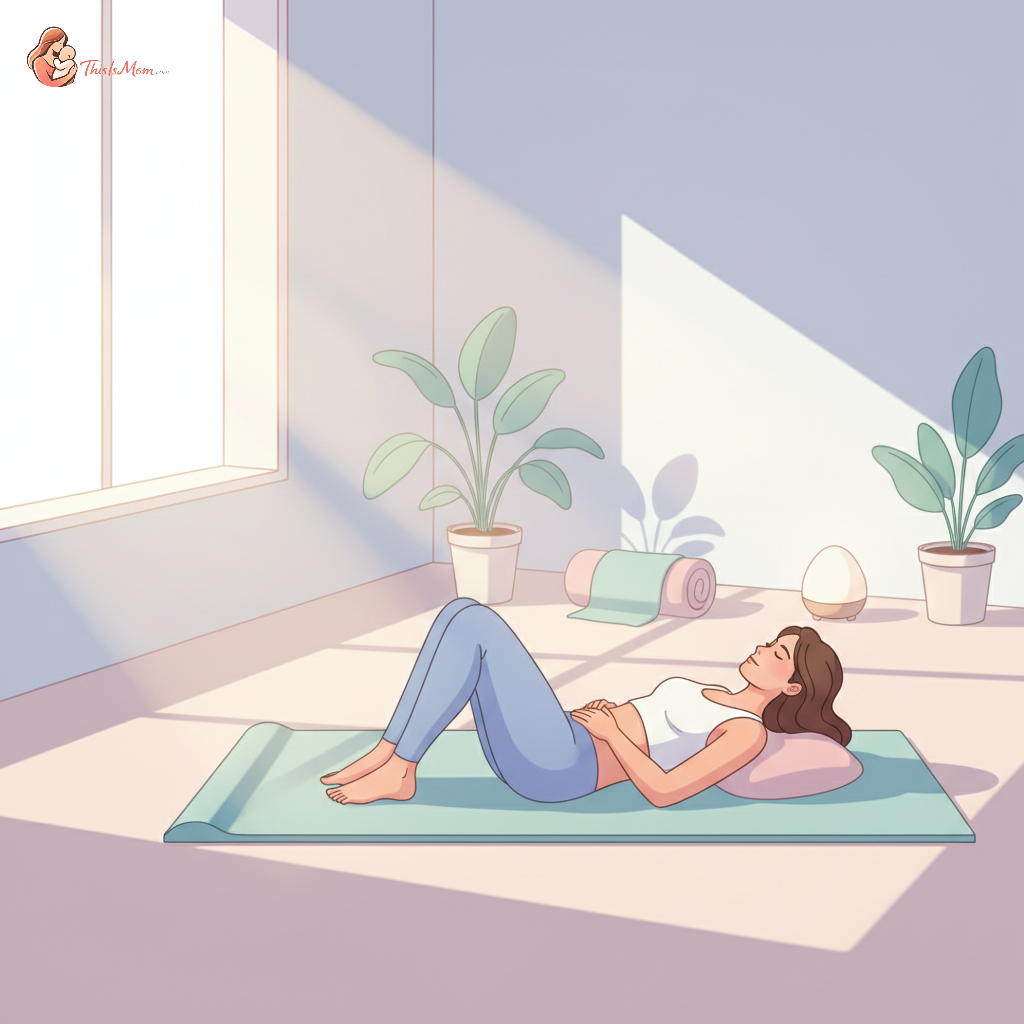
- Diaphragmatic Breathing: Lie on your back with your knees bent. Place one hand on your chest and the other on your belly, below your rib cage. As you inhale, feel your belly and sides expand outwards. As you exhale, gently draw your belly button towards your spine, as if "hugging" inwards. Avoid sucking your stomach in; think of a gentle, controlled exhale. Repeat for 5-10 breaths. This is the bedrock for all postpartum core exercises after a C-section.
Transverse Abdominis (TA) Engagement Basics
Your Transverse Abdominis (TA) is your deepest abdominal muscle, acting like an internal corset. Re-establishing its connection is crucial for core stability.
- TA Activation: While practicing diaphragmatic breathing, focus on that gentle exhale. As you exhale, imagine softly drawing your hip bones together, or gently pulling your belly button towards your spine. It's a subtle squeeze, not a forceful crunch. You should feel a tightening deep in your lower abdomen, below your belly button. Hold for a few seconds on the exhale, then release.
Pelvic Floor Basics: Gentle Kegels
Your pelvic floor muscles work with your core. Learning to engage them properly is key.
- Gentle Pelvic Floor Lifts: With your knees bent, practice diaphragmatic breathing. As you exhale, gently imagine lifting your pelvic floor muscles as if trying to stop urine flow or hold back gas. Aim for a subtle squeeze and lift. Avoid squeezing your glutes or thighs. Hold for a few seconds on the exhale, then relax completely. This is a foundational step for pelvic floor exercises for diastasis recti after a C-section.
Phase 2: Gradual Progression (6-12 Weeks Post-C-Section)
Discover your baby's phase
Once you've established a consistent connection with your breath, TA, and pelvic floor, you can begin to integrate these into gentle movements.
Connecting Breath and Movement: Heel Slides & Pelvic Tilts
These exercises help build control and awareness while coordinating your core and pelvic floor with basic movements.
- Heel Slides: Lie on your back with knees bent, feet flat. Ensure you're engaging your TA and pelvic floor gently on the exhale. As you exhale, slowly slide one heel away, keeping your pelvis stable. Inhale as you slide your heel back in. Repeat with the other leg. Focus on keeping your lower back stable and avoiding any arching or straining.
- Pelvic Tilts: Lie on your back with knees bent, feet flat. Gently exhale, engaging your TA and pelvic floor. As you do this, flatten your lower back into the mat, tilting your pelvis slightly upwards. It's a subtle movement, not a forceful push. Inhale and return to a neutral spine. This helps with spinal mobility and core awareness.
Side Lying Leg Lifts & Clamshells
Working on your sides can be gentler on the abdominal incision and still effectively engage your glutes and outer hips, which support core stability.
- Side-Lying Leg Lifts: Lie on your side with hips and knees stacked and bent at about a 45-degree angle. Keep your core gently engaged. As you exhale, lift your top knee slightly, keeping your feet together. Inhale as you lower. Focus on a smooth, controlled movement.
- Clamshells: In the same side-lying position, keep your feet together and lift your top knee upwards, as if opening a clamshell. Again, focus on controlled movement and gentle core engagement.
Gentle Bridge Variations
Bridges are excellent for glute and back strength, vital components of a healthy core.
- Basic Bridge: Lie on your back with knees bent, feet flat. Gently engage your TA and pelvic floor as you exhale. Squeeze your glutes and lift your hips off the floor, creating a straight line from your shoulders to your knees. Inhale as you slowly lower back down. Ensure you're not over-arching your back.
Phase 3: Building Strength (3+ Months Post-C-Section)
As you approach three months postpartum and continue to feel strong and stable with the Phase 2 exercises, you can begin to introduce more functional movements.
Integrating Core into Daily Movement
The goal is to bring your core awareness into everyday activities.
- Mindful Squats: Stand with feet hip-width apart. As you inhale, begin to lower into a squat, as if sitting back into a chair. Engage your core gently to maintain a stable torso. As you exhale, push through your heels to stand back up, continuing the exhale with your TA and pelvic floor engagement. Start with shallow squats and gradually go deeper as comfortable.
Bodyweight Exercises: Wall Push-ups, Squats (with Core Awareness)
These are great ways to build strength without putting too much direct pressure on your abdomen initially.
- Wall Push-ups: Stand facing a wall, arms extended and hands shoulder-width apart on the wall. Step back so your body is at an angle. Keeping your core engaged and body in a straight line, bend your elbows and bring your chest towards the wall. Exhale as you push back to the starting position. This allows you to control the intensity by adjusting your distance from the wall.
When to Consider Adding Light Weights or Resistance
If you're feeling confident and pain-free with bodyweight exercises, you might choose to incorporate very light weights. This could be light dumbbells for squats or lunges, or resistance bands for exercises like glute bridges or lateral walks. Always prioritize form over weight.
Long-Term Core Health After a C-Section and DR
Rebuilding your core is a marathon, not a sprint. Focus on consistency and listening to your body's cues.
Maintaining Core Connection in Everyday Life
Continue to integrate diaphragmatic breathing and gentle TA/pelvic floor engagement into daily tasks like lifting, bending, and even sitting. This conscious effort helps build lasting strength and support.
Activities to Avoid or Modify
- Traditional Crunches and Sit-ups: These often put too much direct pressure on the linea alba and can worsen DR.
- Heavy Lifting (without proper form): Always engage your core and breathe appropriately when lifting.
- High-Impact Activities: Until your core is significantly healed and strong, avoid running, jumping, or intense plyometrics.
- Anything that causes coning or doming: This is a clear sign the exercise is too much for your current core capacity.
When to Seek Further Professional Guidance
If you're experiencing persistent pain, significant abdominal bulging, urinary or fecal incontinence, or if you feel stuck and unsure how to progress, please reach out to your healthcare provider or a PFPT to learn about pelvic floor therapy exercises for postpartum tailbone pain relief. They can offer advanced assessment and tailored strategies for your C-section recovery and diastasis recti.
Your body has done an incredible job. Healing after a C-section and diastasis recti is a process that requires patience, kindness, and informed choices. Trust that you are capable of finding your way back to core strength in a way that honors your unique journey. Do it your way, at your pace.